◌
Adaptive Bioelectronics
Functional interaction, peripheral interfaces and selective bioelectronic intervention.
Aurealix
Research architecture. Experimental validation. Translation.
Aurealix develops research architectures, experimental technologies and validation infrastructure for adaptive interaction with complex physiological systems.
Functional interaction, peripheral interfaces and selective bioelectronic intervention.
Biological-state dynamics, longitudinal recovery and probabilistic intervention.
Governed infrastructure for reproducible, prospective experimental research.
Two independent initial tracks designed to build evidence before translation.
Research programme
Aurealix combines adaptive bioelectronics with biopharmaceutical and proteostasis research while keeping their initial validation pathways independent.
The longer-term question of convergence remains a research direction, not a prerequisite for either programme.
Track A
Experimental investigation of peripheral bioelectronic interaction, functional mapping, prospective prediction and selective intervention.
Potential future applications include assistive neurotechnology, neuroprosthetic interfaces, selective neuromodulation and pain modulation.
Track B
Experimental investigation of bounded probabilistic intervention alongside longitudinal biological-state and recovery dynamics.
Application-specific and clinical translation follow only where experimental evidence supports progression.
Scientific architecture
The Aurealix Architecture separates scientific frameworks from specific devices, algorithms and patent-protected implementations.
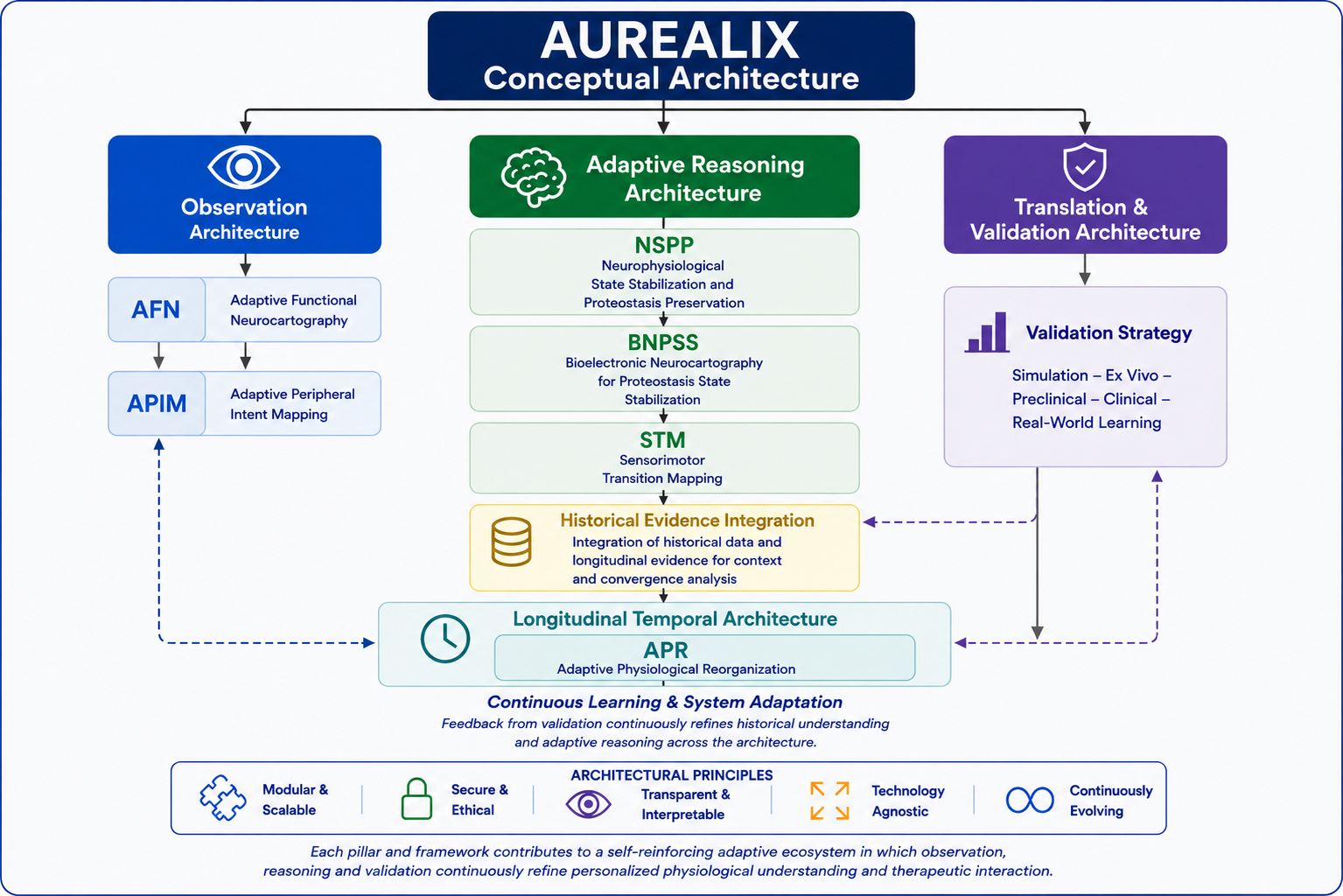
Aurealix Research Platform
ARP is a governed experimental research environment supporting configuration, evidence capture, prospective validation, provenance and longitudinal research.
Intellectual property
Aurealix develops and evaluates intellectual property selectively across adaptive bioelectronics, probabilistic intervention, biological-state research and enabling technologies. Public descriptions remain deliberately distinct from protected implementation detail.
Direction
Research Brief
A concise public overview of Aurealix research architectures, research software, technical selection and the transition toward two independent experimental validation tracks.